
Most owners assume their yacht is insured wherever it goes. Once it leaves the water and travels as cargo, that is often no longer true.
A standard hull policy is written for a yacht that is afloat and under way, and in most cases it doesn't cover the yacht while it is carried on a ship. The owner then has to ask for an extension of the existing policy or take out a new one for the voyage.
Who pays if something goes wrong?
Your hull policy
Usually stops covering the yacht once it is shipped as cargo, unless it has been extended for the voyage.
The carrier
Liability at sea is limited by law and by the contract. A yacht carried on deck can fall outside the standard cargo rules altogether.
Transport insurance
Covers the yacht as cargo for the trip, set to its value and to every leg of the route you put on the policy.
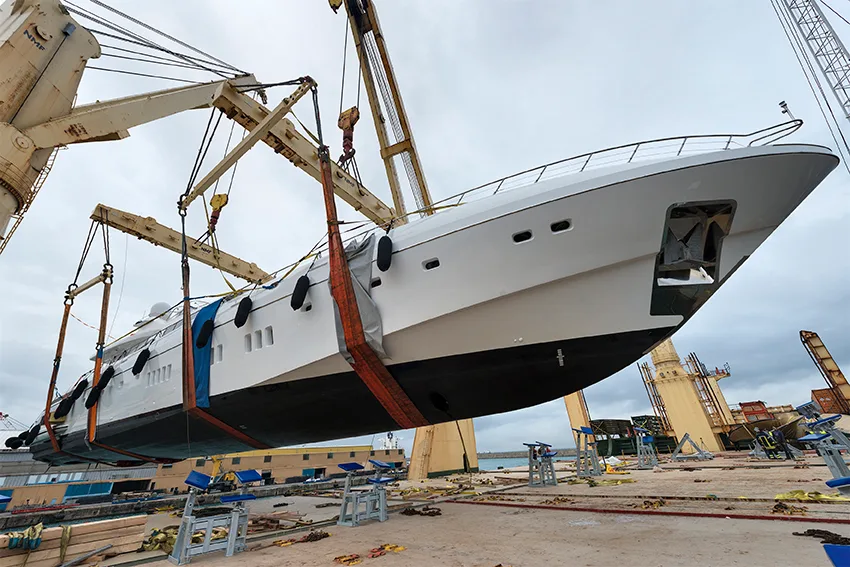
Under the Hague-Visby Rules, which govern a large share of sea carriage, the carrier's liability is capped at 666.67 SDR per package or 2 SDR per kilogram, whichever is higher. For a 20 tonne yacht that is about 40,000 SDR, a small part of what most yachts are worth. The same rules leave out cargo that the contract says is carried on deck and that is actually carried there, which is where yachts usually travel.
SDR: Special Drawing Right, the IMF unit of account used in these rules. Source: Hague-Visby Rules, Articles I and IV.Arranging it yourself, or through us
On your own
- Even a marine insurer needs a long list of details: the yacht, the equipment used, the surveyor and more
- Gathering it all takes time, often when the loading date is close
- An insurer that rarely covers yacht shipments tends to price the risk high
Through Cigisped
- We have worked for over 20 years with an insurance company specialised in yacht transport
- The policy is adapted to your route and to the yacht's value
- It can be issued on the same day you apply, at a competitive rate
- We already hold most of the shipping details the insurer asks for
This cover is there for your peace of mind, but it is optional. You are free to insure the shipment with any insurer you choose.
General average
When a ship faces a common danger at sea, the master may sacrifice part of the cargo or spend money to save the voyage, for example on a salvage tow. Under general average, everyone with property on board shares that cost in proportion to the value they have at stake, even if their own cargo arrived without a scratch.
Until that share is secured, the shipowner can hold the cargo. An uninsured owner is usually asked to sign a general average bond and pay a cash deposit before the yacht is released. With cargo insurance in place, the insurer's guarantee normally takes the place of that deposit.
- 1Danger to the ship and every cargo on it
- 2Sacrifice or extra cost to save the voyage
- 3Cost shared by ship and cargo owners
- 4Security given before the yacht is released
What the insurer will want to know
Insurers can make cover conditional on things like loading supervised by an approved person, so our loading supervision and an independent survey report before and after the voyage often go hand in hand with the policy.
Five things to check in any transit policy
- Deck cover is written inSome cargo policies put anything carried on deck on narrower terms unless agreed otherwise. The policy should say plainly that the yacht is covered on deck.
- Where cover starts and endsFrom the first lift to discharge, or door to door including the trip by road at either end.
- War and strikesThese risks sit in separate clauses and are not included unless they are added.
- Exclusions that matter for yachtsPoor preparation, delay and wear and tear are usually excluded, and some wordings exclude scratching, denting and repainting unless caused by an accident.
- The deductibleThe amount you carry yourself on each claim, stated on the certificate.
Preparation counts here too: see our tips for preparing a yacht for transport.
If you find damage at discharge
Write the damage down before the yacht leaves the port, while the carrier's team is still there.
Take photos, and keep anything broken or removed.
Ask for a surveyor to inspect and record the damage.
Tell us and the insurer straight away, and keep every shipping document.
Questions about transport insurance
Do I have to insure the yacht through Cigisped?
No. The cover we arrange is optional, and you can insure the shipment with your own insurer if you prefer.
Isn't my yacht already covered by its hull policy?
Usually not while it is carried as cargo. Ask your insurer whether the policy covers transport by ship and on deck. If it doesn't, it will need an extension or a separate transit policy.
How quickly can a policy be issued?
Our partner insurer can issue a policy on the same day you apply, once it has the yacht's value and the route.
Can the road part of the trip be covered too?
Yes, if it is part of the route given to the insurer. Tell us every leg, from the marina or yard to the final berth, and the policy is set to match.
Want the yacht insured while it travels? Tell us its value and route, and we'll add transport insurance to your quote.
Get an insured quote