
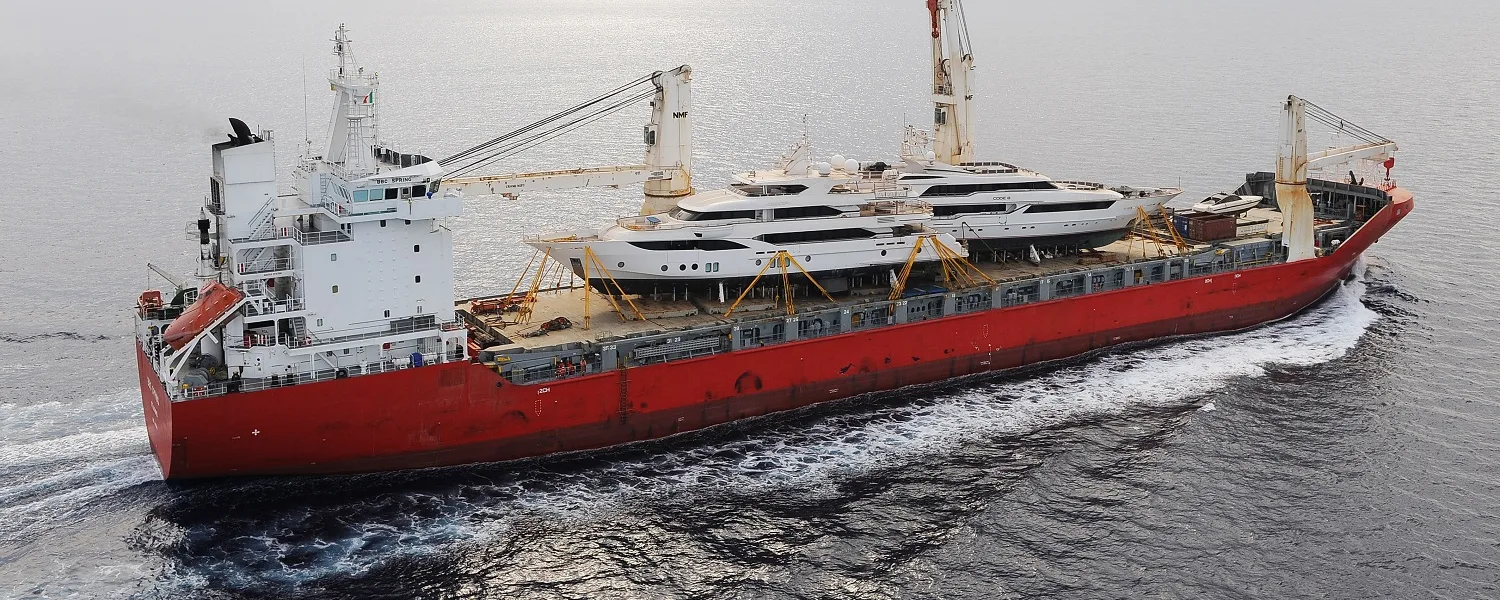
There is more than one way to ship a yacht. The right one depends mostly on its size, then on its weight, its height and the route. Choosing the best-suited carrier for your yacht saves both time and money, and that choice is the first thing we work out with you.
The four methods at a glance
| Method | How it loads | Works best for | Keep in mind |
|---|---|---|---|
| Lift on / lift off | Ship's own cranes lift the yacht onto cradles on deck | Most yachts, many routes, several ports of call | Lifting plan and sling positions must be right |
| Float on / float off | The deck is ballasted below the waterline and the yacht sails in | Large yachts, sailing yachts with masts up | Fixed routes and dates, usually a higher price |
| Roll on / roll off | The boat is rolled up the ship's ramp on a trailer | Boats already on a trailer | Total height, roughly 5 m, is the main limit |
| Container / flat rack | Boat goes into a container, onto a flat rack or as break bulk | Smaller boats, tenders, many ports worldwide | Ships are gearless and depend on port cranes |
Lift on / lift off
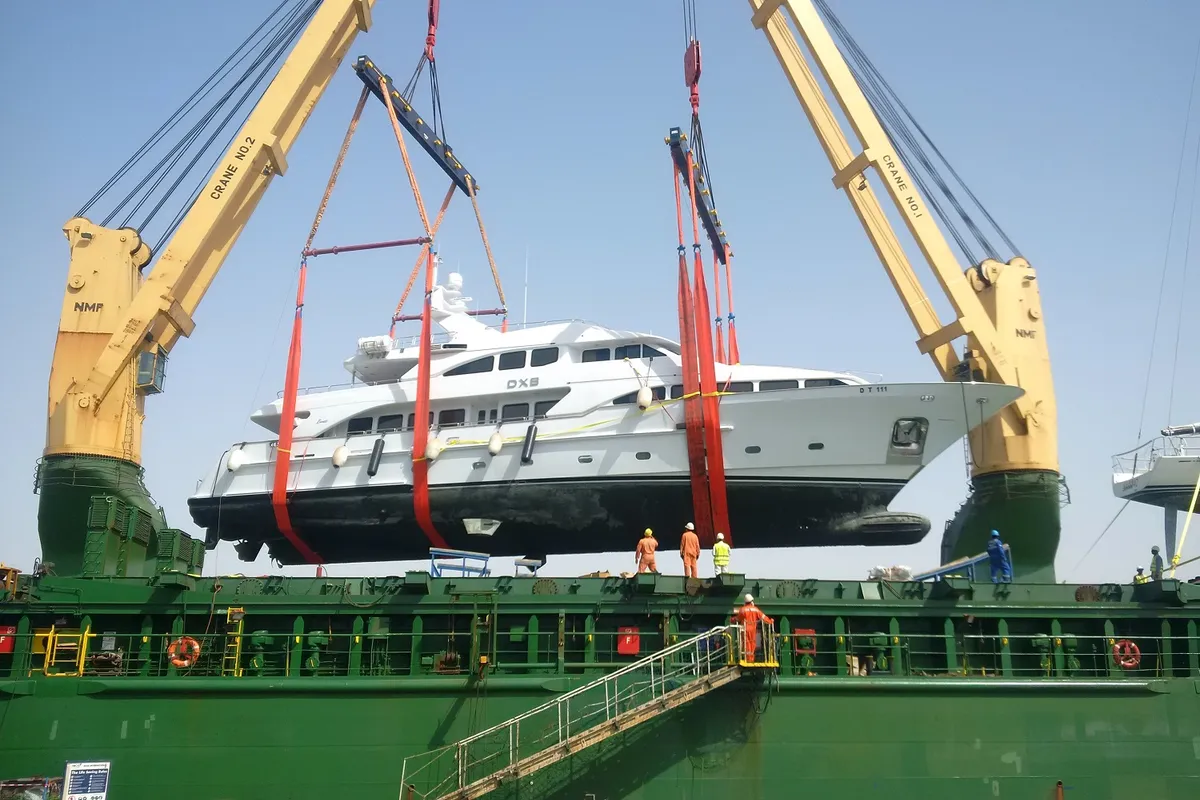
The most common way to ship a yacht. It is carried on a geared or multipurpose ship that works on its own, using its cranes on board, so it doesn't have to rely on the port's gear the way a gearless container ship does.
Before the lift, the sling positions and the cradle are worked out from the yacht's drawings and centre of gravity. On the day, the yacht comes alongside, the slings go under the hull, and the cranes set it down on its cradle on deck, where it is lashed for the voyage.
- 300 to 800 tcombined crane capacity on typical heavy-lift yacht carriers
- Over 70 myachts of this length have been shipped by crane
- 1 to 2 hoursa typical lift, before sea fastening
Liner or charter?
On a geared ship, there are two kinds of service to choose between.
Liner service
This is the service we focus on. Ships run on a published schedule between a fixed set of ports, so we can tell you where the ship will be months ahead. That makes it easy to plan, which matters most for tight deadlines like yacht shows or charters.
Our popular line runs from North Europe (Hamburg, Antwerp) through the Mediterranean (Italy, Greece, Turkey) and the Arabian Peninsula to the Far East (Singapore, Hong Kong, Shanghai, Dalian), with a monthly service from the Mediterranean to Asia and the Far East.
Charter service
Not regular. It runs when there is enough demand, or enough yachts to combine. Chartered ships are usually smaller than liner ships, so their running costs are lower and a detour to load a yacht outside the original route is often possible.
Instead of a fixed date, charter works with a loading window, typically from about 10 days to 6 weeks.
Float on / float off
Best for larger yachts. A semi-submersible ship fills its ballast tanks with water until its deck sits below the waterline. The yachts then come in under their own power and take their positions on deck, with no crane involved.
As the water is pumped out of the ballast, divers secure the cradles under each hull. Although not limited to them, these ships mainly sail between the Mediterranean, the Caribbean, the US East Coast and the Pacific.
Because nothing is lifted, float on/float off is the gentlest option for very large yachts, and it lets sailing yachts travel with their masts up. In return, sailings run on fixed routes and dates, and the price is usually higher.
- 160 mfree deck length on the largest yacht carriers
- 7.5 mmaximum yacht draught that can be floated in
- 0cranes needed to load
Roll on / roll off
Made for boats on trailers. The boat is pulled from the pier and rolled onto the ship over its ramp, often on a low trailer. With no crane involved, there is less handling and the cost goes down.
A boat without a trailer can also travel ro-ro on a cradle, but height is the main limit. As a rule of thumb, the ramp clearance is about 5 metres, including the trailer or cradle, which caps the size of yacht that fits. Masts are laid down for the voyage.

Container, flat rack and break bulk
Container ships are versatile. A boat can go inside a container, on a flat rack, or as loose cargo (break bulk) stowed between other cargo. Container lines call at a very wide range of ports on a regular basis.
Being gearless, they rely on the port's cranes. That means larger yachts can't be handled in every port they call at, so we check the cranes at both ends before booking.
Typical container sizes for boats
| Type | Inside length | Inside width | Inside height | Max payload |
|---|---|---|---|---|
| 20 ft standard | 5.90 m | 2.35 m | 2.39 m | about 30 t |
| 40 ft standard | 12.03 m | 2.35 m | 2.40 m | about 28.8 t |
| 40 ft high cube | 12.03 m | 2.35 m | 2.70 m | about 28.6 t |
| 40 ft open top | 12.03 m | 2.35 m | open roof | about 28.4 t |
| 40 ft flat rack | 11.65 m | 2.35 m | no roof | 44 to 54 t* |
Figures are typical and vary by carrier and container series. *Full flat rack payload only applies when the load is spread along the whole length of the rack.
Which method fits your yacht?
A rough guide to start from. We confirm the right option for your yacht, route and dates.
Getting your yacht ready
- Run fuel and water tanks as low as safely possible
- Drain the bilge and disconnect the batteries
- Lower antennas, radar and anything that adds height
- Remove or secure anything that sticks out, and stow deck anchors
- Tape cabinet doors, lock the exterior and take personal items off
- Remove or cover the sails, and protect windows and fittings
- Have the registration, keys and customs papers ready
- Send us the yacht's drawings so the lifting plan and cradle are right
Questions about shipping methods
Is lift on/lift off safe for my yacht?
Yes. It is the most common way yachts are shipped. The slings and cradle are placed from your yacht's drawings and centre of gravity, and our loadmaster supervises the lift and the lashing.
When is float on/float off the better choice?
For very large yachts, for sailing yachts that need to travel with their masts up, and when the yacht's route matches the ship's fixed schedule.
Can my boat go in a container?
If it fits inside about 12 m by 2.35 m, or on a 40 ft flat rack, yes. It is often the most flexible option for smaller boats, with sailings to many ports.
Liner or charter: which should I choose?
Liner if you want a fixed schedule you can plan around. Charter if your yacht needs a port outside the regular route, accepting a loading window instead of a fixed date.
Not sure whether lift on/lift off, float on/float off or ro-ro suits your yacht? Send us its size and weight, and we'll recommend the method and price it.
Find the right method